Blog

JEKHIPE: Understanding, Confronting, and Transforming Antigypsyism in Europe

JEKHIPE: Understanding, Confronting, and Transforming Antigypsyism in Europe

At the intersection of education, advocacy, and cultural memory, the JEKHIPE project brings forward a collection of infographics, research, and learning tools designed to deepen public understanding of antigypsyism and its enduring impact across Europe. These resources translate complex histories, structural inequalities, and lived experiences into accessible, visually engaging formats—inviting audiences not only to learn, but to reflect and act.

JEKHIPE is a European Commission-funded initiative (CERV) led by ERGO Network, ERIAC, and CEPS, in collaboration with national partners: Slovo 21 (Czechia), Central Council for German Sinti and Roma (Germany), UCRI and Romni (Italy), Amare Romentza (Romania), FAGiC and Romane Siklovne (Spain), and Trajosko Drom (Sweden). Together, these organizations address historical injustices, such as the lack of recognition for the Roma Holocaust and slavery, while promoting institutional representation in arts and education. By engaging policy-makers and grassroots communities, JEKHIPE seeks to contribute to the establishing of clear mechanisms for governmental accountability across Europe.

Infographics for Public Engagement

The core infographic series offers a comprehensive exploration of key themes that define Roma experiences and the structures that affect them. These include:

Recognizing that antigypsyism manifests differently across national contexts, JEKHIPE also presents country-specific infographics that delve into structural realities and policy environments:

National infographics:

  • Germany – From Memory to Action: Confronting Antigypsyism in Modern Germany [View Infographic: In English/ In German]
  • Spain – Unfinished Justice: Understanding Structural Antigypsyism [View Infographic: In English/ In Spanish]
  • Czechia – From Exclusion to Equity: Breaking the Cycle of Antigypsyism [View Infographic: In English/ In Czech]
  • Romania – Legacy of Exclusion: Unmasking Structural Inequality [View Infographic: In English/ In Romanian]
  • Sweden – Unseen Barriers The Structural Reality of Being Roma in Sweden [View Infographic: In English/ In Swedish]
  • Italy – Unrecognized and Unequal The Struggle for Roma Rights [View Infographic: In English/ In Italian]

Each national case study reflects both shared European patterns and distinct historical trajectories, offering a nuanced perspective on how antigypsyism is reproduced—and how it can be dismantled.

Tools for Change: From Awareness to Action

Beyond awareness, JEKHIPE equips civil society actors, educators, and policymakers with practical tools:

Guidelines on the Promotion of Roma Identity, History, and Culture

Civil Society Toolbox on Countering Antigypsyism

These resources provide concrete strategies for inclusive communication, advocacy, and community engagement, ensuring that knowledge leads to meaningful change.

Research and Policy Insights

The project is grounded in rigorous research and policy analysis. A series of reports and briefs examine both national and European dimensions of antigypsyism:

Researches and policy briefs

Antigypsyism in the Czech Republic: From Recognition to Transitional Justice?

Institutional Weaknesses and Relational Voids: Historically Rooted Structural Barriers in Countering Antigypsyism in Italy

Latest Developments, Strategies and Recommendations to Combat Antigypsyism in Romania

Latest Developments, Strategies and Recommendations to Combat Antigypsyism in Spain

Latest Developments, Strategies and Recommendations to Combat Antigypsyism in Sweden

Policy brief JUSTICE, INTERRUPTED: Revisiting transitional justice, truth and reconciliation efforts at the EU level and in Germany, Romania, Spain and Sweden

National policy recommendations:

National Policy Recommendations on Fighting Antigypsyism in the Czech Republic

National Policy Recommendations on Fighting Antigypsyism in Italy

National Policy Recommendations on Fighting Antigypsyism in Romania

National Policy Recommendations on Fighting Antigypsyism in Spain

National Policy Recommendations on Fighting Antigypsyism in Sweden

These documents identify structural barriers, highlight institutional gaps, and propose actionable recommendations for more effective and equitable policies.

Learning Through Masterclasses

JEKHIPE also fosters critical dialogue through a series of expert-led masterclasses, featuring scholars, activists, and practitioners who bring diverse perspectives on history, resistance, and cultural memory. Topics range from civil rights movements and artistic resistance to national histories and identity construction, offering participants an in-depth and reflective learning experience.

MasterclassAntigypsyism in Germany: Historical Continuities, Civil Rights Movement, Scholarship, and Artistic Resistance, with Silas Kropf

Masterclass Antigypsyism in Sweden and Romani Interventions, with Samanta Selimovic

Masterclass Anti-Gypsyism, Resistance, and Cultural Memory: A Critical Perspective from Spain, with Fernando Ruiz Molina

Masterclass Antigypsyism in Italy through the History of the Roma Civil Rights Movement, with anthropologist Federica Scrimieri

Masterclass Prince Ștefan Răzvan: The Construction and Deconstruction of a Roma Hero in the Context of Romanian History and National Memory, with historian Adrian-Nicolae Furtună

These resources represent more than an educational initiative, they are a call to action. By making antigypsyism visible, understandable, and actionable, the project empowers individuals and institutions to challenge discrimination and support Roma inclusion.

JEKHIPE Masterclass with Nikola Ludlová

JEKHIPE Masterclass with Nikola Ludlová

The European Roma Institute for Arts and Culture (ERIAC) is releasing the masterclass Roma Culture and Arts as Political Practice in Czechoslovakia, with Nikola Ludlová, produced in the framework of the project Reclaiming Our Past, Rebuilding Our Future: New Approaches to Fighting Antigypsyism (JEKHIPE).

This masterclass examines how Roma culture and the arts have functioned as a form of political practice, particularly in Czechoslovakia. It begins by highlighting the broader power of art across history as a tool for shaping ideas, evoking empathy, and influencing social and political change. Within this context, it focuses on the politics of representation, showing how Roma have long been depicted by non-Roma in ways that reinforced exclusion and stereotypes, and how cultural production became a crucial means of self-representation and resistance.

The lecture then traces the development of Roma cultural activism, from early individual figures like Elena Lacková to the collective efforts of the Union of Gypsies–Roma (1969–1973), which connected cultural work with political demands for recognition and rights. Despite later suppression, these initiatives laid the foundation for ongoing cultural expression and institutional development.

About the author

With a background in contemporary history and Romani studies, Nikola Ludlová works across multiple disciplinary and professional contexts. As independent historian, she has focused on the entanglement of science and politics, specifically in the area of knowledge production on Roma. In cultural sector, she is dedicated to advancing social justice and environmental responsibility in the arts, rethinking institutional models to make them more inclusive and accessible. Her expertise spans decolonial aesthetics, critical museology, relational and identitarian art, and participatory art mediation that opens space for both broad audiences and groups historically excluded from access to culture. In her emerging curatorial practice, she approaches curatorship as a social practice grounded in dialogue, care, and collective agency.

JEKHIPE Research in Czechia by Gwendolyn Albert

Six research fellows from Germany, Spain, Italy, Romania, Czechia, and Sweden were selected to produce in-depth papers documenting historical and contemporary forms of antigypsyism, Roma civil rights movements, and cultural history in their national contexts. These papers are designed to generate new historical evidence, enrich academic and policy debate, and inform public-facing outputs. Each study is published in both the national language and English to ensure accessibility at local and European levels.

The paper Czech Antigypsyism and Roma Cultural Resistance, authored by Gwendolyn Albert, explores the enduring history of antigypsyism in the Czech lands, detailing a legacy of systemic exclusion that spans from the Holy Roman Empire to the modern day. It documents critical human rights violations, including the Roma and Sinti genocide during the Holocaust, postwar forced sterilizations that continued into the 21st century, and the state-mandated assimilation and segregation of the communist era. The research notes that even in the post-1989 democratic transition, Roma communities have faced ongoing challenges, such as systemic educational discrimination and the rise of racially motivated violence by ultra-right groups.

In response to this oppression, the paper highlights a robust history of Roma resistance and cultural preservation. It details how Roma have used literature, music, and visual arts to reclaim their narratives and fight against erasure. From the establishment of institutions like the Museum of Romani Culture to contemporary legal battles against school segregation and for forced sterilization compensation, the research illustrates how Roma activism continues to challenge societal status quos. Ultimately, the paper emphasizes that while artistic and political resistance has successfully crossed into mainstream awareness, achieving full human rights for Roma remains an unfulfilled social necessity.

About the author

Gwendolyn Albert is a human rights activist and a Roma ally. For more than a decade she has been communicating information to the Council of Europe, the European Commission, the International Federation of Gynecology and Obstetrics, the OSCE and the UN High Commissioner for Human Rights about issues affecting Roma in Europe (mainly on dignified remembrance of Romani Holocaust victims, discrimination against Romani children in education, and the forced sterilization of Romani women). Since 2004 she has collaborated with civil society organizations both domestically in the Czech Republic and internationally on a broad range of human rights issues, including cost-free access to legal aid, how to re-educate domestic violence perpetrators, and safeguarding the rights of asylum seekers. In August 2020 she was given the Award for Humanity by the Committee for the Redress of the Roma Holocaust in the Czech Republic in recognition of her work on the issue of redress for those who have been forcibly sterilized in the former Czechoslovakia and Czech Republic. She received the Alice G. Masaryk Human Rights Award from the Embassy of the United States of America to the Czech Republic in 2021, together with Elena Gorolová and Monika Šimůnková, for her work on that same issue.

Read the Research Paper “Czech Antigypsyism and Roma Cultural Resistance” authored by Gwendolyn Albert:

JEKHIPE Project Closing Conference at Roma Week 2026

JEKHIPE Project Closing Conference at Roma Week 2026

Roma Week, a European platform dedicated to Roma equality, inclusion, and justice, will take place from 21–23 April 2026 in Brussels, convening policymakers, civil society, and Roma communities to shape the future of participation and rights across Europe.

The programme spans high-level discussions, advocacy spaces, and cultural moments, addressing the future of Roma inclusion under the new EU budget, combating antigypsyism, housing and energy challenges, youth empowerment, and gender and intersectional issues.

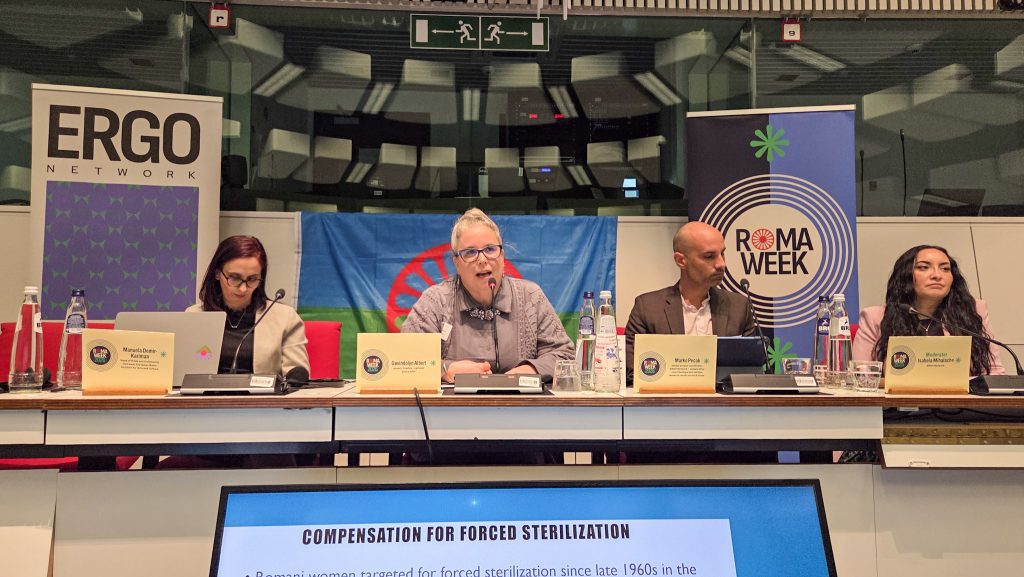
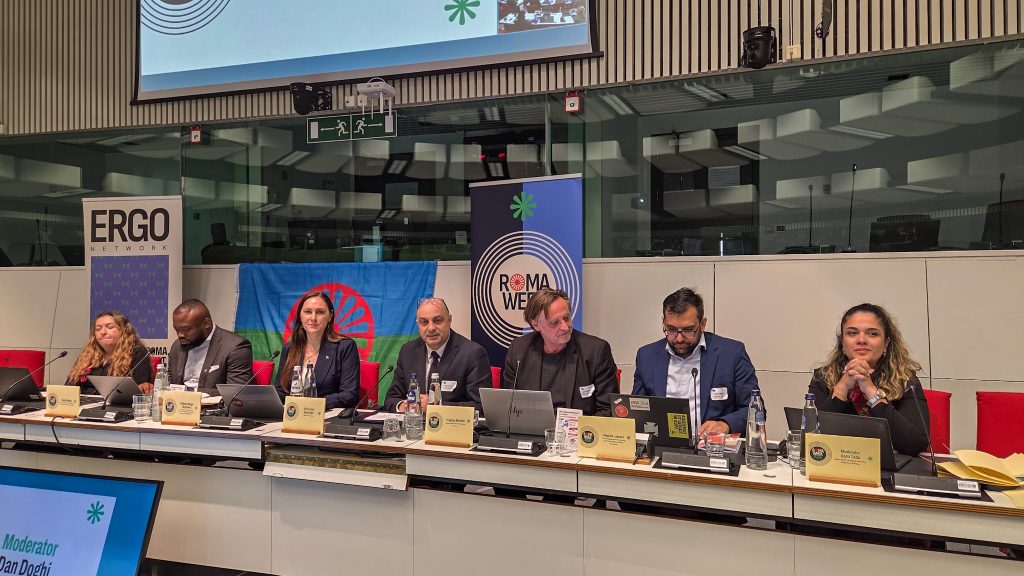
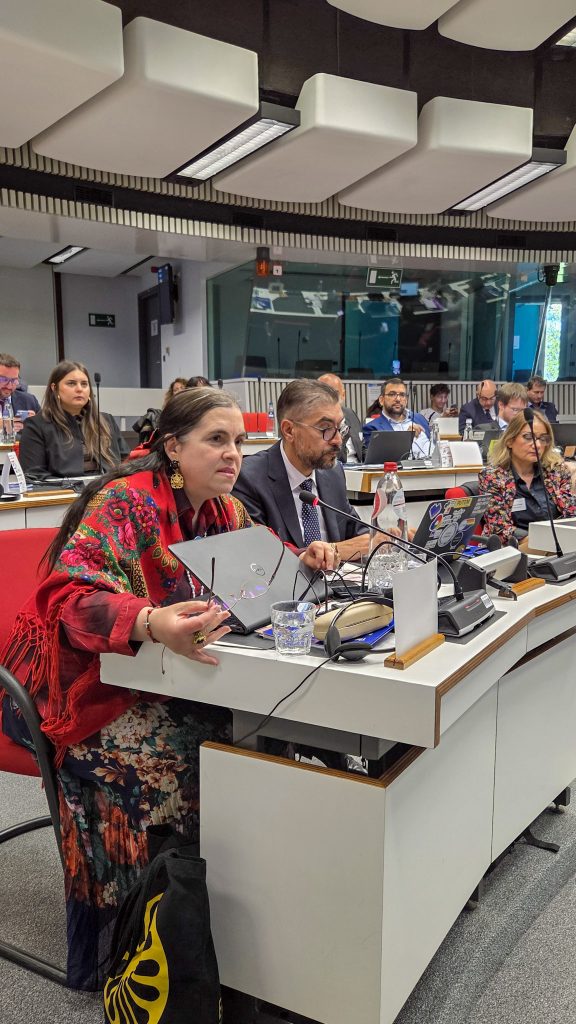
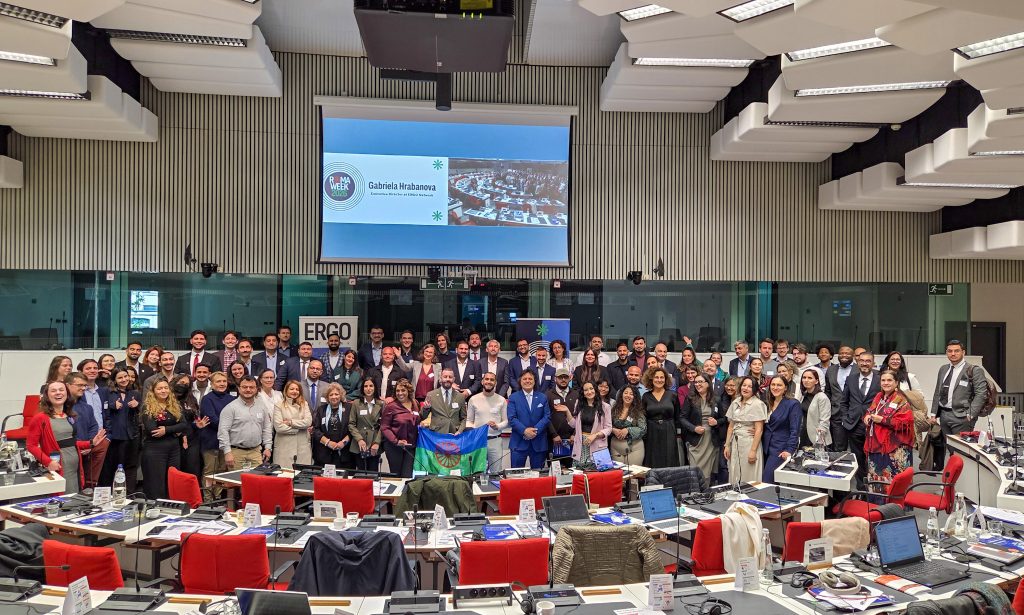
The conference “Reclaiming our past, rebuilding our future: Transitional Justice and the Fight Against Antigypsyism in Europe,” marking the closing of the JEKHIPE project, will take place on 22 April.

Explore the Roma Week 2026 agenda at https://romaweek.eu/.

JEKHIPE High-Level ConferenceReclaiming our past, rebuilding our future: Transitional Justice and the Fight Against Antigypsyism in Europe

Date: 22 April 2026
Time: 12:30–14:40 (followed by coffee break 14:40–15:00)
Venue: European Economic and Social Committee (EESC)
Rue Van Maerlant 2, 1040 Brussels
Room: VMA22

Co-organised by: ERGO Network and Centre for European Policy Studies

Agenda:

12:30 – 12:50 | Opening Remarks

Moderate: Sergio Carrera, Center for European Policy Studies (CEPS)

  • Claude Cahn, Office of the United Nations High Commissioner for Human Rights (OHCHR), Regional Office for Europe (online)
  • Manuela Demir-Kariman, Head of Pride and Community Outreach, European Roma Institute for Arts and Culture

12:50 – 13:20 | Evidence from Chachipen and Jekhipe initiatives – new perspectives on transitional justice

  • Marko Pecak, Jekhipe project coordinator, ERGO Network – comparative view Chachipe and Jekhipe research results across Europe 
  • Gwendolyn Albert, expert, Czechia – national policy brief

13:20 – 13:50 | Transitional Justice in wider Europe
Moderator: Dan Doghi, expert, Romania

  • Elżbieta Mirga-Wójtowicz, Jaw Dikh Foundation and Centre of Migration Research University of Warsaw 
  • Stephan Mueller, Council for German Sinti and Roma

13:50 – 14:35 | High-Level Dialogue – From Recognition to Accountability
Moderator: Oana Taba, Roma and Travellers Division, Council of Europe

  • Marcela Adamova, Roma Team Leader, DG JUST, European Commission
  • Mustafa Jakupov, The Antigypsyism Reporting and Information Center, Germany
  • Ismael Cortez, academic, expert, Spain
  • Enya Echeng, African Union Reference Group on Transitional Justice in Africa

14:35 – 14:40 | Closing Reflections

  • Sergio Carrera, Center for European Policy Studies (CEPS)

JEKHIPE Infographics for Public Engagement

Across Europe, the marginalization of Roma communities remains underrepresented in public debate and often overlooked in policy discussions. To address this gap, JEKHIPE project partners are releasing a series of infographics designed to communicate these realities by presenting research findings in a clear and accessible visual format.

Grounded in 2025 findings from partner countries (Romania, Italy, Spain, Czechia, Germany, and Sweden), these materials are designed to bridge the gap between research insight and public understanding. Each infographic is available in both English and national languages to broaden the engagement across local and international audiences.

At the core of the research is the argument that contemporary structural antigypsyism cannot be understood in isolation from its historical roots. The analysis traces a long continuum of exclusion, from early measures such as 15th-century bans in Italy and the centuries-long enslavement of Roma in the Romanian Principalities, to the Roma Holocaust, during which over 500,000 Roma were murdered. Subsequently, the infographics address the ongoing lack of recognition and justice for these crimes, illustrating how historical persecution forms the foundation of contemporary discrimination, antigypsyist incidents, and exclusionary policies across Europe.

Building on this evidence, the JEKHIPE project calls for moving beyond symbolic commitments toward meaningful, structural change. Its findings point to a persistent gap between policy frameworks and their implementation on the ground, and are accompanied by concrete recommendations aimed at strengthening accountability, improving policy execution, and advancing genuine inclusion for Roma communities across Europe.

Funded by the European Union. Views and opinions expressed are however those of the author(s) only and do not necessarily reflect those of the European Union or the granting authority. Neither the European Union nor the granting authority can be held responsible for them.

JEKHIPE Infographics for Public Engagement

Country-specific infographics:

  • Germany – From Memory to Action: Confronting Antigypsyism in Modern Germany [View Infographic: In English/ In German]
  • Spain – Unfinished Justice: Understanding Structural Antigypsyism [View Infographic: In English/ In Spanish]
  • Czechia – From Exclusion to Equity: Breaking the Cycle of Antigypsyism [View Infographic: In English/ In Czech]
  • Romania – Legacy of Exclusion: Unmasking Structural Inequality [View Infographic: In English/ In Romanian]
  • Sweden – Unseen Barriers The Structural Reality of Being Roma in Sweden [View Infographic: In English/ In Swedish]
  • Italy – Unrecognized and Unequal The Struggle for Roma Rights [View Infographic: In English/ In Italian]

About JEKHIPE

JEKHIPE is a European Commission-funded initiative (CERV) led by ERGO Network, ERIAC, and CEPS, in collaboration with national partners: Slovo 21 (Czechia), Central Council for German Sinti and Roma (Germany), UCRI and Romni (Italy), Amare Romentza (Romania), FAGiC and Romane Siklovne (Spain), and Trajosko Drom (Sweden). Together, these organizations address historical injustices, such as the lack of recognition for the Roma Holocaust and slavery, while promoting institutional representation in arts and education. By engaging policy-makers and grassroots communities, JEKHIPE seeks to contribute to the establishing of clear mechanisms for governmental accountability across Europe.

Together, these organizations address historical injustices, such as the lack of recognition for the Roma Holocaust and slavery, while promoting institutional representation in arts and education. By engaging policy-makers and grassroots communities, JEKHIPE seeks to contribute to the establishing of clear mechanisms for governmental accountability across Europe.

JEKHIPE Masterclass with Silas Kropf

The European Roma Institute for Arts and Culture (ERIAC) is releasing the masterclass Antigypsyism in Germany: Historical Continuities, Civil Rights Movement, Scholarship, and Artistic Resistance, with Silas Kropf produced in the framework of the project Reclaiming Our Past, Rebuilding Our Future: New Approaches to Fighting Antigypsyism (JEKHIPE). This masterclass builds on his professional and academic expertise and is informed by the findings of Maria Bogdan’s fellowship paper Antigypsyism in Germany: Historical Continuities, Civil Rights Movement, Scholarship, and Artistic Resistance, developed for the JEKHIPE project.

This masterclass explores antigypsyism as a persistent and multifaceted form of racism, tracing its roots from the early marginalization of Sinti and Roma to the Nazi genocide, which drew on long-standing practices of exclusion and racialization. It also examines the postwar experiences of survivors, who continued to face discrimination and denial of recognition, and highlights the emergence of a civil rights movement led by figures such as Vinzenz, Oskar, and Romani Rose, whose activism was crucial in securing the official recognition of the genocide in 1982.

Bringing the discussion into the present, the masterclass presents antigypsyism as a structural issue that persists across media, digital spaces, and institutions such as education, housing, and policing. It also foregrounds Roma artistic practices—memoir, music, theater, and memorial art—as powerful forms of cultural memory and resistance. By connecting history, activism, scholarship, and art, this masterclass offers a deeper understanding of both the enduring nature of antigypsyism and the ongoing efforts to challenge it.

About the authors

Maria Bogdan is a media and cultural theorist with a background in social sciences. Her research explores media representation, racism, cultural memory, and cultural trauma, with a focus on Roma. She earned her Ph.D. in Film, Media, and Culture Theory from Eötvös Loránd University in Budapest in 2018. A Fulbright alumna, she has been a Fortunoff Research Fellow at the Vienna Wiesenthal Institute for Holocaust Studies and the first Romani Rose Postdoctoral Research Fellow at Heidelberg University. She is a founding member and managing editor of Critical Romani Studies and has extensive experience as a journalist and film critic.

Silas Kropf is an organisational and social pedagogue and a German Sinto, with many years of experience as a consultant in education and civil society engagement. He has been a member of the Independent Commission on Antigypsyism on behalf of the German Federal Government and is committed to promoting social participation and strengthening democracy. Currently a doctoral researcher at Humboldt University of Berlin, his work focuses on antigypsyism, democracy competence, and intersectionality, alongside his broader engagement in empowerment and civil society initiatives.

Read the Research Paper “Antigypsyism in Germany: Historical Continuities, Civil Rights Movement, Scholarship, and Artistic Resistance” Authored by Maria Bogdan

This masterclass is based on a research study produced by Maria Bogdan,and developed within the JEKHIPE project. Six research fellows from Germany, Spain, Italy, Romania, Czechia, and Sweden were selected to produce in-depth papers documenting historical and contemporary forms of antigypsyism, Roma civil rights movements, and cultural history in their national contexts.

These papers are designed to generate new historical evidence, enrich academic and policy debate, and inform public-facing outputs. Each study is published in both the national language and English to ensure accessibility at local and European levels. Together, they form the foundation for a series of masterclasses that translate the research into accessible audiovisual formats for wider audiences.

 
Disclaimer: Funded by the European Union. Views and opinions expressed are however those of the author(s) only and do not necessarily reflect those of the European Union or the European Commission. Neither the European Union nor the granting authority can be held responsible for them

JEKHIPE Masterclass with Samanta Selimovic

The European Roma Institute for Arts and Culture (ERIAC) is releasing the masterclass Antigypsyism in Sweden and Romani Interventions, with Samanta Selimovic, based on a research paper authored by Samanta Selimovic and Jan Selling, produced in the framework of the project Reclaiming Our Past, Rebuilding Our Future: New Approaches to Fighting Antigypsyism (JEKHIPE).

This masterclass, led by Samanta Selimovic, provides a critical examination of the five-century history of the Roma in Sweden, moving from the violent 1637 expulsion decrees to the 2013 illegal police registration. By blending academic research with lived experience as a Roma and Muslim woman, Selimovic exposes “antigypsyism” not merely as a prejudice, but as a systemic structure embedded within the Swedish welfare state. The session highlights how historical “humanitarian” policies often masked forced sterilization and cultural erasure, ultimately arguing that genuine inclusion fails when it is designed for Roma rather than with them.

Shifting from systemic exclusion to “artivism,” the session explores how pioneers like the Taikon sisters and contemporary figures like Soraya Post and Lindy Larsson reclaim Roma identity through politics and performance. After noting the influence of the post-Yugoslavia diaspora and women’s leadership, the session concludes by analyzing the “state-dependency dilemma”: the tension between requiring public funding and maintaining activist independence against rising populism. Ultimately, the masterclass calls for structural reform and collective memory to ensure Sweden’s 2032 equality goals are met through active participation rather than passive assimilation.

About the authors

Samanta Selimovic is an activist, advisor and representative in Roma issues, active both nationally and internationally. She has been involved in several cultural and social projects, including ‘Roma cultural heritage in Västernorrland’, the identity project ‘Young Roma voices’ and initiatives that support Roma towards studies and work. Selimovic is also a driving force in a Roma cultural association in Sundsvall, with a special focus on women’s rights, the fight against antigypsyism, and the strengthening of Roma identity and culture. She has described her path to becoming a Roma activist in the essay “Existensen” [The Existence.] (2024, in: B., L. Lundqvist & J. Olsson (eds) Feminiqua. Historier om motstånd. [Feminiqua. Stories of Resistance], pp. 282–291.

Jan Selling is a professor of critical Roma studies at Södertörn University. Since 2010, he has researched and taught about Roma history, Roma liberation and antigypsyism. Main publications: Svensk antizigansim [Swedish Antigypsyism] (2013), Romani Liberation (2022; also in Swedish version as Frigörelsen, 2020), reports on Sweden for the projects CHACHIPEN (2022) and JEKHIPE (2025) and participation in RomArchive 2015-2019 and ERIAC’s project Re-Thinking Roma resistance (2020). At Södertörn University, he has been conducting an international online colloquium for doctoral students with a focus on antigypsyism and critical Roma studies since 2020.

Read the Research Paper “Antigypsyism in Sweden and Romani Interventions” Authored by Samanta Selimovic and Jan Selling

This masterclass is based on a research study produced by Samanta Selimovic and Jan Selling, and developed within the JEKHIPE project. Six research fellows from Germany, Spain, Italy, Romania, Czechia, and Sweden were selected to produce in-depth papers documenting historical and contemporary forms of antigypsyism, Roma civil rights movements, and cultural history in their national contexts.

These papers are designed to generate new historical evidence, enrich academic and policy debate, and inform public-facing outputs. Each study is published in both the national language and English to ensure accessibility at local and European levels. Together, they form the foundation for a series of masterclasses that translate the research into accessible audiovisual formats for wider audiences.

Read the Research Paper “Antigypsyism in Sweden and Romani Interventions” Authored by Samanta Selimovic and Jan Selling (available in English and Swedish)

 
Disclaimer: Funded by the European Union. Views and opinions expressed are however those of the author(s) only and do not necessarily reflect those of the European Union or the European Commission. Neither the European Union nor the granting authority can be held responsible for them

JEKHIPE Masterclass with Fernando Ruiz Molina

For centuries, the Roma in Spain have navigated a landscape of institutionalized exclusion. The masterclass Anti-Gypsyism, Resistance, and Cultural Memory: A Critical Perspective from Spain, with Fernando Ruiz Molina, uncovers the hidden threads of this history: the laws that criminalized an identity, the repression of the Franco era, and the quiet persistence of inequality today.

However, the story of the Roma is not just one of victimhood, it is one of fierce political and cultural resistance. Fernando Ruiz Molina explores the transformative power of the post-1978 associative movement and the revolutionary leadership of Roma women. Explore why true reconciliation in Spain can only begin when we acknowledge the truth of its structural antigypsyism.

About the author

Fernando Ruiz Molina is a Ph.D. Candidate in Criminology at the University of Plymouth, funded by a Marie Sklodowska-Curie fellowship. A human rights lawyer by training, he has over 14 years of experience in Roma activism at local, national, and international levels. He worked at OSCE/ODIHR on Roma and Sinti issues and currently presides over CHANIPEN: Research, Memory and Justice, a Roma organization in Spain. His work focuses on hate perpetration against Roma and developing theoretical frameworks for anti-Roma racism.

This masterclass is based on a research study produced by Federica Scrimieri and developed within the JEKHIPE project. Six research fellows from Germany, Spain, Italy, Romania, Czechia, and Sweden were selected to produce in-depth papers documenting historical and contemporary forms of antigypsyism, Roma civil rights movements, and cultural history in their national contexts.

These papers are designed to generate new historical evidence, enrich academic and policy debate, and inform public-facing outputs. Each study is published in both the national language and English to ensure accessibility at local and European levels. Together, they form the foundation for a series of masterclasses that translate the research into accessible audiovisual formats for wider audiences.

Read the Research Paper “Anti-Gypsyism, Resistance, and Cultural Memory: A Critical Perspective from Spain” Authored by Fernando Ruiz Molina (available in English and Spanish)

 
Disclaimer: Funded by the European Union. Views and opinions expressed are however those of the author(s) only and do not necessarily reflect those of the European Union or the European Commission. Neither the European Union nor the granting authority can be held responsible for them

Guidelines on the Promotion of Roma Identity, History, and Culture

For centuries, Roma communities have been foundational to the economic, political, and artistic fabric of Europe, yet they remain systematically sidelined in national narratives. Effective communication is not about speaking for Roma communities, but about ensuring Roma are the primary authors of their own stories. Beyond aesthetics, Roma cultural production serves as a powerful tool for resistance, documenting survival and challenging the structural “invisibility” of antigypsyism.

The Guidelines on the Promotion of Roma Identity, History, and Culture, created by the European Roma Institute for Arts and Culture (ERIAC), represent an extensive evidence-gathering on how narratives are currently perceived in the JEKHIPE project countries: Romania, Belgium, Italy, Germany, Spain, the Czech Republic, and Sweden. They are designed to help practitioners move from “symbolic gestures” toward “structural participation,” where Roma artists and scholars hold shared authority in museums, media, and policy frameworks.

The guidelines provide a strategic framework for creating compelling messages that avoid the “victimhood” trap. Instead, they center on:

  • Agency and Contribution: Highlighting Roma as active historical actors and democratic contributors.
  • Intersectionality: Acknowledging the diversity within the community, including gender, age, and sexual orientation, to break down monolithic stereotypes.
  • Public Memory: Using public spaces and commemorative practices to negotiate a shared history that includes Roma testimonies alongside official documents.

Building inclusive societies requires a sustained commitment to narrative sovereignty. When Roma are recognized as the co-authors of Europe’s story, cultural democracy becomes a reality rather than a concept.

JEKHIPE Masterclass with Federica Scrimieri

How do Roma and Sinti communities transform centuries of systemic bias into powerful movements for change? Anthropologist Federica Scrimieri joins the JEKHIPE project to trace the history of Italian antigypsyism and the resilient civil rights movement it sparked.

The masterclass Antigypsyism in Italy through the History of the Roma Civil Rights Movement, with anthropologist Federica Scrimieri, is produced in the framework of the project Reclaiming Our Past, Rebuilding Our Future: New Approaches to Fighting Antigypsyism (JEKHIPE).

This masterclass analyzes Italian antigypsyism from the 1920s to the present, examining the systemic violence and institutional bias that have marginalized Roma and Sinti communities. Federica Scrimieri traces the evolution of Romani resistance, from early “pioneer” networks to modern “artivists” who use digital media to challenge dominant narratives. By examining artistic production as a site of memory and political agency, the masterclass illustrates how these cultural movements complement the ongoing intergenerational fight against entrenched structural inequalities in housing, education, and the social system.

About the author

Federica Scrimieri is a professional anthropologist with a Ph.D. in Social and Cultural Anthropology from the University of Milano-Bicocca. She has lectured at the University of Verona and is a member of the Permanent Seminar on Roma Studies at CREAa. She has worked with Roma communities since 2013, focusing on Roma civil rights in Albania and anti-Gypsyism in Italy. Her research combines anthropology, oral history, and participant observation to study activism, memory, and Roma/Sinti resistance.

This masterclass is based on a research study produced by Federica Scrimieri and developed within the JEKHIPE project. Six research fellows from Germany, Spain, Italy, Romania, Czechia, and Sweden were selected to produce in-depth papers documenting historical and contemporary forms of antigypsyism, Roma civil rights movements, and cultural history in their national contexts.

These papers are designed to generate new historical evidence, enrich academic and policy debate, and inform public-facing outputs. Each study is published in both the national language and English to ensure accessibility at local and European levels. Together, they form the foundation for a series of masterclasses that translate the research into accessible audiovisual formats for wider audiences.

Read the Research Paper “Antigypsyism in Italy through the History of the Roma Civil Rights Movement” Authored by Federica Scrimieri (available in English and Italian)

 
Disclaimer: Funded by the European Union. Views and opinions expressed are however those of the author(s) only and do not necessarily reflect those of the European Union or the European Commission. Neither the European Union nor the granting authority can be held responsible for them

JEKHIPE Masterclass with Historian Adrian-Nicolae Furtună

The masterclass Prince Ștefan Răzvan: The Construction and Deconstruction of a Roma Hero in the Context of Romanian History and National Memory, with historian Adrian-Nicolae Furtună, produced in the framework of the project Reclaiming Our Past, Rebuilding Our Future: New Approaches to Fighting Antigypsyism (JEKHIPE).

The masterclass explores how Ștefan Răzvan, who ruled Moldavia between April and August 1595, became a lasting figure in Romanian debates about identity and memory, shaped in part by claims of his Romani origins and his alliance with Mihai Viteazul against the Ottomans. It traces historiographical disputes sparked by Nicolae Bălcescu, who framed Răzvan as a symbol of emancipation, versus critics who cast him as an illegitimate usurper, embedding ethnic stereotypes in national memory.

The session then examines Răzvan’s literary reinvention in Răzvan Vodă by Bogdan Petriceicu Hașdeu, which elevated him to heroic status, a move contested by figures like P. P. Carp. Concluding with modern Romani reinterpretations that integrate Răzvan into a narrative of resistance and empowerment in a move to reclaim heritage, the masterclass shows how proverbs, literature, and activism have continually reshaped Răzvan’s image, revealing how history and memory intersect in constructing collective identity.

About the author

Adrian-Nicolae Furtună is a Ph.D. candidate in sociology at the Research Institute for Quality of Life, Romanian Academy. His doctoral thesis addresses the social memory of Roma slavery. He coordinates the Romano Rodipe Research Program on Roma History at the National Centre for Roma Culture and is a member of the Centre for the History of Eugenics and Racism in Cluj-Napoca. His work focuses on memory–history relations, Roma slavery, and the deportation of Roma to Transnistria during the Holocaust.

This masterclass is based on a research study produced by Adrian-Nicolae Furtună and developed within the JEKHIPE project. Six research fellows from Germany, Spain, Italy, Romania, Czechia, and Sweden were selected to produce in-depth papers documenting historical and contemporary forms of antigypsyism, Roma civil rights movements, and cultural history in their national contexts.

These papers are designed to generate new historical evidence, enrich academic and policy debate, and inform public-facing outputs. Each study is published in both the national language and English to ensure accessibility at local and European levels. Together, they form the foundation for a series of masterclasses that translate the research into accessible audiovisual formats for wider audiences.

Read the Research Paper “Prince Ștefan Răzvan: The Construction and Deconstruction of a Roma Hero in the Context of Romanian History and National Memory” Authored by Adrian-Nicolae Furtună (Available in English and Romanian)