Antigypsyism is frequently regarded as “normal” by Czech-language users of social media, where its presence is both structural and widespread. Those are the findings of the international project Together Against Antigypsyism Online (TAAO), documenting hundreds of Czech-language hate speech posts against Romani people on social media.
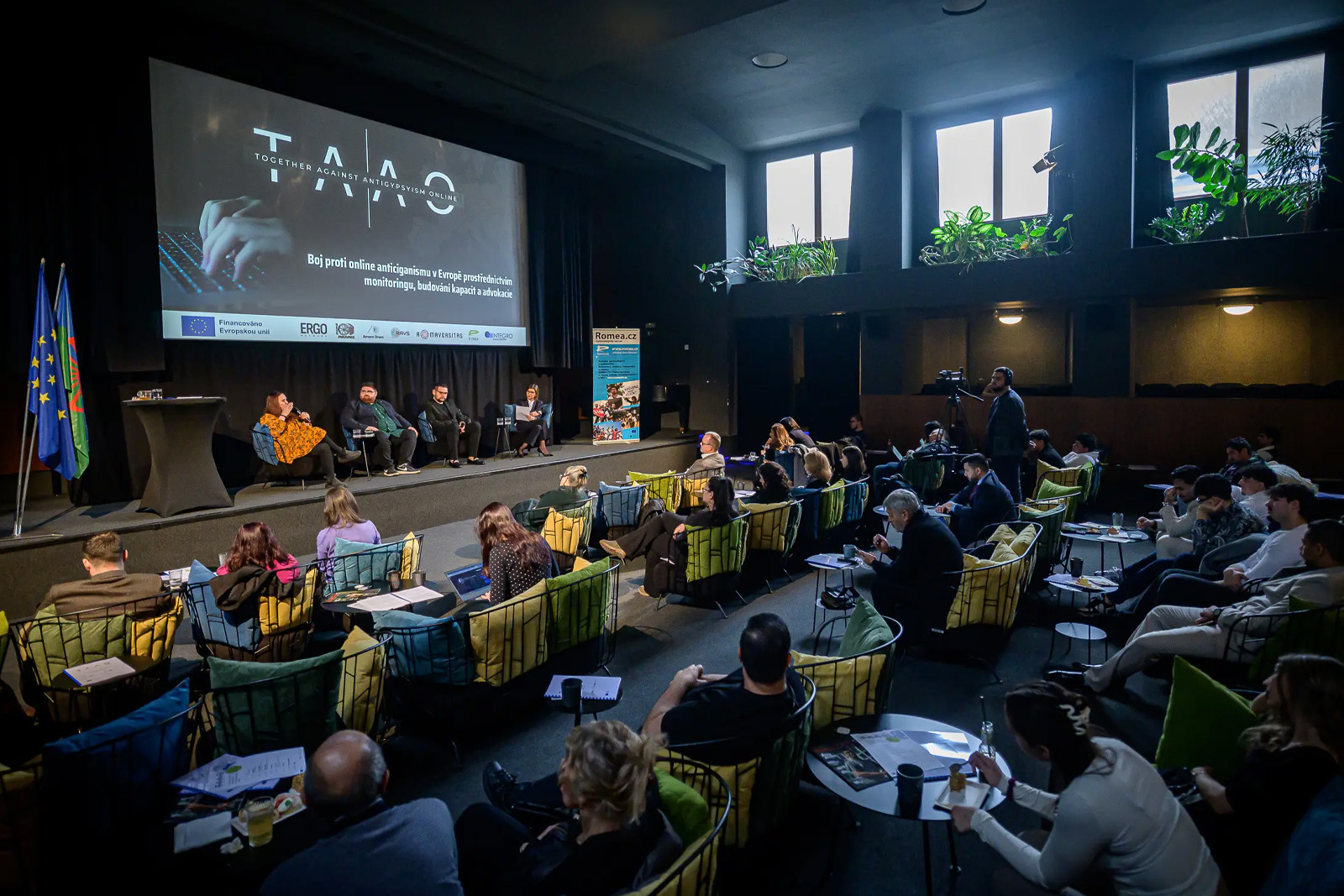
The conclusions drawn from the project were presented by the ROMEA organization at a conference on Thursday, 22 January 2026. The conference was broadcast live online by ROMEA TV.
The TAAO project ran from March 2024 to February 2026 in six European countries and involved seven partner organizations. In the Czech Republic it was realized by the ROMEA organization.
The aim of the project was to monitor online antigypsyism systematically, analyze its forms and impacts, and strengthen the role of Romani youth as active researchers and agents of social change. “In the Czech Republic, we carried out the research in cooperation with Romani youth, who monitored hateful content through their own accounts on Facebook, X, TikTok, Instagram and YouTube,” said project manager Štefan Balog.
“Over the course of one year, we documented 505 specific cases of hate speech. Antigypsyism appeared most frequently on Facebook, especially in comments under media articles and in groups with a local focus. X also had a significant share, where hatred was often hidden behind the language of ‘rational’ debate, pseudo-scientific arguments, or political framing,” added Balog.
TikTok played a specific role during the period under review, where anti-Romani content spread mainly in the form of Duets, mocking videos, parodies, and visual remixes. “These formats spread easily and are frequently amplified by social media algorithms. The research reveals that social media platforms are not neutral; their operations can contribute to the legitimization and normalization of hatred,” added Balog.
FULL RECORDING OF THE CONFERENCE
The final report identifies hateful narratives on Czech-language social media that repeatedly associate Romani people with crime, alleged lower intelligence, and welfare abuse. A common motif is pseudoscientific claims about a “genetic” predisposition to such behavior, used to legitimize racism as an “expert opinion” or rational conclusion.
Such narratives appear especially in political commentaries and debates, where Romani people are portrayed as a societal threat. The project authors state that antigypsyism is deeply rooted and structural, not marginal or exceptional.
The conference included a debate led by Klára Kalibová, director of In IUSTITIA, focusing on strengthening trust in public institutions and translating research findings into practice. Viktor Kundrák from the Office of the Government of the Czech Republic noted that a comprehensive set of recommendations addressing bias crime and hate speech, including online forms, has been created in cooperation with civil society and the police.
PHOTO GALLERY

According to Kundrák, these recommendations emphasize victim protection and respond to the transformation of hatred in digital space.
Andrea Bučková from ARA ART noted that monitoring activities focused on hatred against Romani people have increased in recent years and share similar conclusions.
Jan Lata from the Prosecutor General’s Office stated that criminal law can mainly address the most serious forms of hate speech, such as calls for violence or genocidal language.
Panelists agreed that an effective response to hatred against Romani people requires a combination of educational, preventive, and legal measures, interagency cooperation, and long-term community involvement.
Balog highlighted the impact of online hate on Romani youth, including exhaustion, fear, shame, and limited participation in public online spaces. “Online antigypsyism functions as psychological violence with real consequences,” he said.
ROMEA also addresses online hatred internationally, including through the INACH network.
A representative of ROMEA participated in a meeting at TikTok’s European headquarters in Dublin, where platform representatives explained their moderation processes. Follow-up discussions focused on gaps in addressing anti-Romani content.
“It is important that TikTok reflects on these suggestions and engages in dialogue about improvements,” said Kristian Szinai, ROMEA’s communications manager.
The conference was moderated by journalist Iveta Demeterová and featured a speech by Government Commissioner for Roma Minority Affairs Lucie Fuková.
The conference recording is available on Romea.cz and on ROMEA TV’s social media profiles, including YouTube.
Share on Facebook Post on Twitter


